Affiliate Disclosure: This article contains affiliate links. As an Amazon Associate, I earn from qualifying purchases. If you buy something through one of my links, I may earn a small commission at no additional cost to you.
Amazon reviews can be incredibly useful.
They can also be overwhelming.
A product might have 4.6 stars from 15,000 reviews, making it look like an obvious choice. But when you start reading the reviews, you may discover complaints about broken parts, poor quality, incorrect sizing, or products that don’t match the description.
So how do you know which reviews deserve your attention?
The answer isn’t to ignore Amazon reviews. It’s to learn how to read them properly.
In this guide, we’ll show you how to read Amazon reviews, identify useful patterns, understand labels such as Verified Purchase and Vine Customer Review, use review-analysis tools, and spot recurring problems before you spend your money.
Why You Shouldn’t Look Only at the Star Rating
The first thing most shoppers notice is the star rating.
For example:
★★★★★ 4.7 out of 5
That’s useful information, but it doesn’t tell you everything.
A product can have a high average rating while still having a serious problem that matters to you.
Imagine you’re buying a kitchen organizer.
Most customers might love its appearance and give it five stars.
But imagine that 10 different customers independently mention:
“The handle broke after a few weeks.”
That’s important.
Even if the product has thousands of positive reviews, a repeated complaint about the same component could reveal a potential durability problem.
This is why patterns are often more useful than individual reviews.
How to Read Amazon Reviews Step by Step
When we’re researching products, we don’t simply look at the overall rating.
Instead, we use a process.
Step 1: Look at the Overall Rating
Start with the average rating to get a general impression.
But don’t stop there.
A rating gives you a starting point, not a final answer.
Step 2: Check How Many Reviews There Are
There’s a big difference between:
4.8 stars from 12 reviews
and
4.6 stars from 12,000 reviews.
The number of reviews provides additional context.
However, quantity alone doesn’t guarantee quality.
Step 3: Read the Negative Reviews
This is one of the most important steps.
Don’t be afraid of one-star, two-star, or three-star reviews.
In fact, negative reviews can sometimes tell you more about a product than five-star reviews.
Why?
Because happy customers often say:
“Works great!”
A disappointed customer may explain exactly what went wrong.
Look for Patterns, Not Isolated Complaints
One negative review doesn’t necessarily mean a product is bad.
People can receive defective units.
Someone might use a product incorrectly.
A product might simply not suit that particular person’s needs.
But repeated complaints are different.
Imagine you’re researching a storage container.
You find:
- Review 1: “Lid cracked after two months.”
- Review 2: “The lid is fragile.”
- Review 3: “Mine cracked after a few weeks.”
- Review 4: “Container is good, but the lid broke.”
- Review 5: “The lid needs to be stronger.”
Now you’ve identified a pattern.
The important question isn’t:
“Is there one negative review?”
It’s:
“Do multiple customers independently report the same problem?”
Pay Special Attention to Repeated Problems
When reading reviews, watch for recurring complaints about:
Durability
- Handles breaking
- Cracks
- Parts falling off
- Zippers failing
- Wheels breaking
- Batteries dying quickly
Size
- Smaller than expected
- Larger than expected
- Measurements aren’t accurate
- Doesn’t fit the intended space
Quality
- Cheap materials
- Weak plastic
- Poor stitching
- Thin construction
- Flimsy components
Functionality
- Doesn’t work as advertised
- Difficult to assemble
- Missing features
- Doesn’t perform well under normal use
Compatibility
- Doesn’t fit certain devices
- Doesn’t work with a particular model
- Accessories don’t fit
- Wrong connector or size
If the same issue appears repeatedly, take it seriously.
Don’t Ignore Three-Star Reviews
Many shoppers jump directly from five-star reviews to one-star reviews.
That’s a mistake.
Three-star reviews can be particularly useful because they often contain a mixture of positive and negative observations.
For example:
“The organizer looks good and is easy to assemble, but the drawers are difficult to open when they’re full.”
That’s much more useful than simply:
“Great product!”
A three-star reviewer may explain the trade-offs that a five-star reviewer didn’t mention.
What Does “Verified Purchase” Mean?
You may notice a label such as:
Verified Purchase
on some Amazon reviews.
This indicates that Amazon has associated the review with a purchase of the product through its system.
That’s useful information, but it shouldn’t automatically mean:
Verified Purchase = perfect review
A verified customer can still write a positive, negative, or inaccurate review.
The label provides context about the purchase relationship; you should still read what the reviewer actually says.
What Is an Amazon Vine Review?
You may also see reviews labeled something like:
Vine Customer Review of Free Product
These reviews come from Amazon’s Vine program.
Amazon describes Vine as a program where invited reviewers, known as Vine Voices, receive eligible products and provide their opinions. Amazon says Vine reviewers are selected based on the quality and helpfulness of their previous reviews.
Amazon’s current community guidelines also state that Vine reviews are clearly identified as reviews of free products and that Vine Voices are expected to provide honest, unbiased opinions.
So should you ignore Vine reviews?
No.
Instead, understand what you’re reading.
The reviewer received the product through the Vine program rather than purchasing it in the normal way.
That doesn’t automatically make the review positive or negative.
A good Vine review can still provide extremely useful information.
Vine vs. Verified Purchase
Here’s a simple comparison:
| Review Type | What It Means |
|---|---|
| Verified Purchase | Amazon has associated the review with a purchase |
| Vine Review | Reviewer received the product through Amazon Vine |
| Regular Review | Review without those particular labels |
| Negative Review | Customer describes problems or dissatisfaction |
| Positive Review | Customer describes a positive experience |
Don’t treat these labels as automatic quality scores.
Instead, consider them pieces of information that help you understand the review.
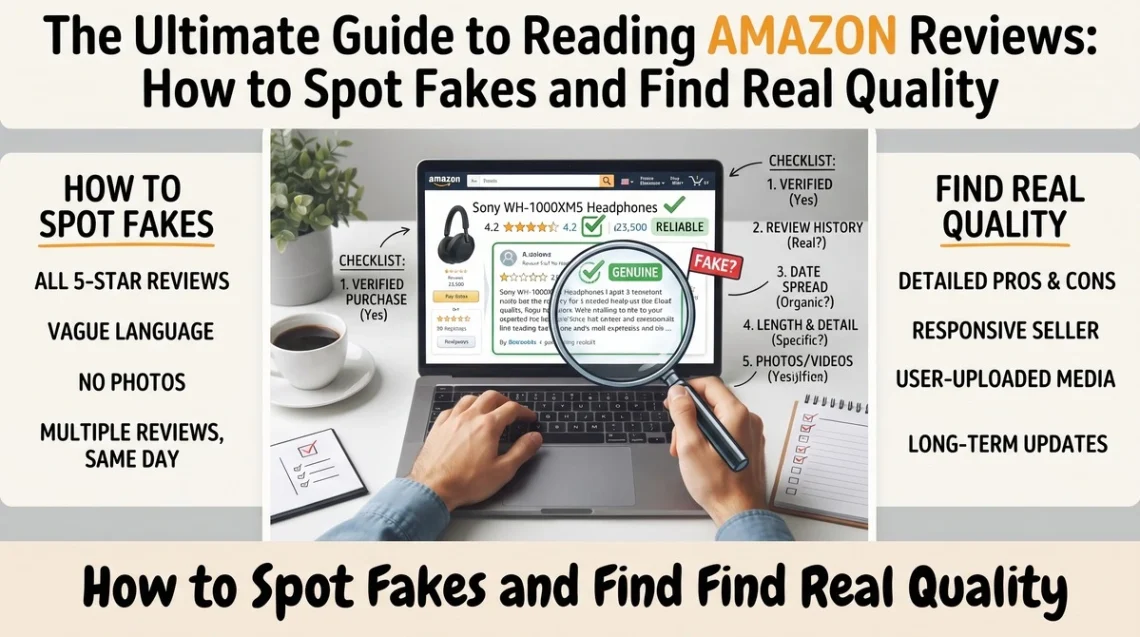
How to Spot Suspicious Reviews
There isn’t a single trick that can tell you with certainty whether every Amazon review is genuine.
Instead, look for unusual patterns.
Warning Sign #1: Extremely Generic Reviews
Examples:
“Amazing product!”
“Great quality!”
“Highly recommended!”
These reviews provide very little useful information.
A detailed review explaining how someone actually used the product is much more informative.
Warning Sign #2: Repetitive Language
If many reviews appear to use nearly identical wording, pay attention.
For example:
- “Amazing quality!”
- “Amazing quality and highly recommended!”
- “Excellent quality and highly recommended!”
- “Very good quality, highly recommended!”
This doesn’t prove that the reviews are fake.
But repetitive language can be a reason to investigate further.
Warning Sign #3: Reviews That Don’t Match the Product
Pay attention to reviews that seem unrelated to the product you’re looking at.
If a reviewer talks about a completely different product, size, or use case, don’t assume the review tells you something useful about the current listing.
Amazon can group reviews across product variations or related listings in ways that require additional context.
Warning Sign #4: Huge Numbers of Reviews in a Short Period
A sudden burst of reviews can deserve additional scrutiny.
Look at the review dates when possible.
A product with years of steady customer feedback presents a different review history from one that appears to have accumulated a huge number of reviews in a very short period.
Again, this isn’t proof of manipulation.
It’s simply another signal worth investigating.
Use Review Analysis Tools
If you don’t want to manually inspect hundreds of reviews, third-party analysis tools can help.
ReviewMeta
ReviewMeta analyzes Amazon product reviews and attempts to identify reviews that its algorithms consider potentially unnatural.
You can paste an Amazon product URL into ReviewMeta and receive an analysis of the review data. ReviewMeta also provides an adjusted rating based on the reviews it retains in its analysis.
However, there is an important limitation:
Don’t treat ReviewMeta’s result as absolute proof that reviews are fake or genuine.
ReviewMeta itself states that its PASS/FAIL/WARN results do not necessarily prove the presence or absence of fake reviews.
Think of it as another research tool.
How to use ReviewMeta
- Find the Amazon product.
- Copy the product page URL.
- Open ReviewMeta.
- Enter the Amazon URL.
- Review the analysis.
- Look at which reviews or patterns were flagged.
- Compare those findings with the actual Amazon reviews.
The goal isn’t to blindly follow the adjusted rating.
The goal is to investigate the product more intelligently.
What About Fakespot?
You may see older articles recommending Fakespot.
Fakespot was a popular review-analysis service that used algorithms to identify potentially unreliable review patterns.
However, this information is now outdated.
Mozilla announced that Fakespot would shut down, and its website, apps, extensions, and Firefox Review Checker were discontinued in 2025.
So if you find an old article telling you to install Fakespot, be aware that it is no longer a current option.
That’s also a good reminder to check the publication date of articles recommending shopping tools.
Don’t Let Review Analysis Tools Make the Decision for You
Tools can be useful, but they aren’t magic.
An algorithm doesn’t know exactly what matters to you.
For example, suppose a review-analysis tool flags some reviews as suspicious.
That doesn’t automatically mean the product itself is poor.
Likewise, a product with a clean-looking review profile isn’t automatically perfect.
Use tools as research assistants, not as your final decision-maker.
Read Reviews Based on Your Specific Needs
This is one of the most important review-reading techniques.
Imagine you’re buying an under-bed storage container.
You don’t necessarily care whether someone says:
“The color is beautiful.”
You care about things like:
- Does it fit under the bed?
- Is it sturdy?
- Does the lid stay closed?
- Are the wheels useful?
- Is it easy to pull out?
- Does it collapse?
- Does it hold the advertised amount?
Search the reviews for the features that matter to you.
Your definition of a good product may be completely different from another shopper’s.
Use Amazon’s Review Search When Available
If Amazon provides review-search functionality for the product, use it.
For example, if you’re purchasing a storage organizer, search reviews for:
“handle”
Then try:
“broken”
“size”
“durable”
“assembly”
“plastic”
This can save you a tremendous amount of time.
Instead of reading hundreds of reviews from beginning to end, you can investigate the issues that matter most.
Look at Customer Photos
Customer-uploaded photographs can be extremely useful.
Professional product photographs are designed to make the product look its best.
Customer photos show you how the product actually looks in someone’s home.
Look for:
- Actual size
- Material quality
- Color
- Construction
- Assembly
- How it looks after use
- How it compares with the manufacturer’s photographs
For home organization products especially, customer photographs can reveal whether the product actually fits into the kind of spaces shown in the listing.
Read the Most Recent Reviews
Product quality can change.
Manufacturers may change:
- Materials
- Suppliers
- Design
- Packaging
- Manufacturing processes
- Product versions
That’s why older reviews don’t always tell you what you’re buying today.
Look at recent reviews as well as older ones.
If older reviews consistently praise a product but recent reviews suddenly complain about quality, that’s worth investigating.
It doesn’t automatically prove that the product changed, but it gives you a reason to look more closely.
Don’t Ignore Positive Reviews
This guide isn’t about finding reasons not to buy something.
Positive reviews can provide valuable information too.
Look for detailed comments explaining:
- Why the product works
- How it is being used
- How long it has lasted
- What features are particularly useful
- What type of customer would benefit from it
A detailed five-star review can be extremely valuable.
The key is specificity.
Build Your Own Review Scorecard
For products we’re researching, you can create a simple scorecard.
| Factor | What to Look For |
|---|---|
| Overall rating | General customer sentiment |
| Review count | Amount of available feedback |
| Recent reviews | Current customer experience |
| Negative reviews | Repeated problems |
| Positive reviews | Consistent strengths |
| Verified Purchase | Purchase context |
| Vine reviews | Free-product review context |
| Customer photos | Real-world appearance |
| Product-specific complaints | Potential weaknesses |
| Review patterns | Repeated themes |
This gives you a much more complete picture than simply looking at the number of stars.
How We Read Amazon Reviews for Our Buying Guides
This is where product research can become extremely time-consuming.
Imagine you’re comparing:
20 products
with:
2,000 reviews each.
That’s potentially 40,000 reviews.
Most shoppers don’t have the time to read all of them.
That’s where our buying guides come in.
We research products, examine customer feedback, compare specifications, look for recurring complaints, and identify the features that matter for a particular use case.
Instead of asking you to spend hours digging through thousands of reviews, our goal is to turn that information into something easier to understand.
In other words:
You shouldn’t have to become a product-research expert just to buy a storage organizer.
That’s the job our buying guides are designed to make easier.
Our Affiliate Relationship
Some of the products we discuss on this website are linked through affiliate links.
If you click one of our Amazon links and make a qualifying purchase, we may earn a small commission at no additional cost to you.
That commission helps support:
- Product research
- Website hosting
- Content creation
- Buying guides
- Product comparisons
- Website maintenance
You don’t pay extra for using our affiliate links.
However, an affiliate relationship doesn’t mean every product is right for every person.
Our goal is to explain the available information and help you make your own decision.
The 5-Minute Amazon Review Method
If you don’t have time to read hundreds of reviews, try this quick process.
Minute 1: Check the overall rating
Get a general idea of customer sentiment.
Minute 2: Read several recent negative reviews
Look for recurring complaints.
Minute 3: Read several detailed positive reviews
Find out what customers actually like.
Minute 4: Search for specific problems
Search terms such as:
- broken
- durability
- size
- quality
- return
- defective
- assembly
Minute 5: Compare the patterns
Ask yourself:
“Are the negative comments isolated incidents, or do multiple customers report the same problem?”
If you can answer that question, you’ve already done much more useful research than simply looking at the star rating.
The Bottom Line
Learning how to read Amazon reviews can save you from making disappointing purchases.
Don’t rely on the star rating alone.
Instead:
- Read negative reviews
- Look for repeated complaints
- Read three-star reviews
- Check recent feedback
- Examine customer photographs
- Understand Verified Purchase labels
- Understand Amazon Vine reviews
- Use review-analysis tools such as ReviewMeta
- Be cautious with unusual review patterns
- Focus on the features that matter to you
Most importantly, look for patterns rather than isolated comments.
One person saying a handle broke doesn’t tell you much.
Ten independent customers reporting the same broken handle is a much more useful signal.
That’s the difference between simply reading reviews and actually researching reviews.
And that’s exactly what we try to do with our buying guides: cut through the noise so you don’t have to spend hours digging through thousands of reviews yourself.